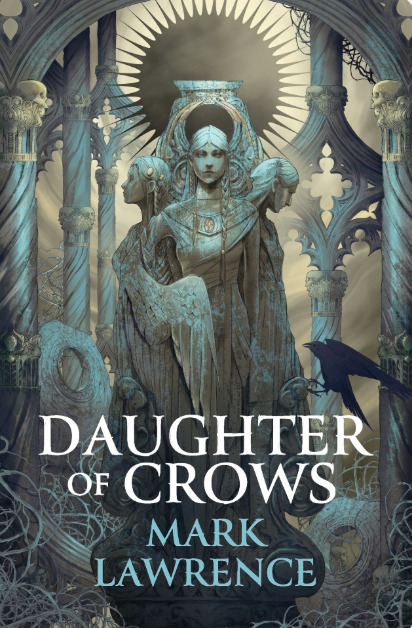
Daughter of Crows by Mark Lawrence
The opening paragraph of Daughter of Crows — Mark Lawrence's first novel in his new Academy of Kindness trilogy, published March 2026 — announces what the book intends to be without softening the announcement: "All of the people I hate are dead. Some of them I didn't even kill. Perhaps that's why I'm still angry. Perhaps if it had been my hand on the knife, my eyes the last thing they saw, perhaps then I would be at peace. Perhaps."
That word at the end — perhaps — does the work. It is the doubt of someone who knows the violence she is capable of and has learned not to trust the story she tells herself about what it would accomplish. It belongs to a character who has been defined by rage for so long that she cannot fully imagine what she would be without it. And it signals, from the novel's first page, that Lawrence is writing about something more difficult and more interesting than revenge.
The Structure
Daughter of Crows operates across three timelines, which is an ambitious structural choice and one that Lawrence executes with more discipline than it initially appears to require.
The primary present-day narrative follows Rue, a former assassin of the Academy of Kindness who has spent her later years building a quiet life in a remote village. She is over sixty. Her body does not answer her demands the way it once did. She has made friends — a condition she would once have considered a liability — and the destruction of those friends by violence she did not invite is what pulls her back into a world she believed she had left behind.
The second timeline follows a cohort of girls entering the Academy of Kindness. Each year, one hundred are sold to the Academy. After a decade of instruction in the Wound Garden and the Bone Garden, three emerge. The Academy's halls, Lawrence makes clear immediately, are not a school in any conventional sense. The comparison that multiple reviewers have reached for is Squid Game — the policy is student deaths, the pedagogy is survival. It is brutal in ways that the novel earns through specificity rather than spectacle, and it is where the book's most emotionally affecting material lives.
The third timeline, belonging to a character called the Eldest, arrives later and with a quality of horror that the other two timelines do not share. It is deliberately disorienting, and it is not fully explained. This is a first-volume problem — the Eldest sections set up questions the trilogy will need to answer — but the disorientation is also the point. Lawrence wants the reader slightly off-balance, uncertain of the relationship between what they are reading and what they already understand. The tactic works.
Rue and the Problem of the Elderly Protagonist
The decision to center Daughter of Crows on a woman in her sixties is the book's most significant creative choice and, in the context of the fantasy genre, its most unusual one. The genre has produced elderly wizards and aged kings in abundance, but the elderly woman as action protagonist — not as mentor, not as peripheral figure, not as the character whose death motivates the younger hero — is genuinely rare.
Lawrence makes Rue's age functional rather than decorative. Her body's limitations are not an obstacle the narrative ignores; they are a structural element of the tension. She is still dangerous, but not reliably so. The gap between what she intends and what she can physically accomplish in any given moment generates a kind of suspense that the invulnerable hero cannot. And her relationship to her own past — to the violence she committed and the person it made her — is informed by decades of living with the consequences in ways that a younger character's reckoning simply cannot replicate.
Grimdark Magazine's review identifies Rue as "Lawrence's most compelling exploration of identity in years." The assessment is accurate. She is a figure defined by what she has tried to bury but what others keep forcing her to exhume, and the novel's central question — whether rage is a wound that heals or a condition that becomes permanent — is asked through her specifically because her age makes the question more urgent. She has less time to find out.
Lawrence's Prose
Lawrence's prose has always been his clearest distinguishing quality in the grimdark genre. It is economical without being cold, precise without being clinical, and capable of a dry wit that lands precisely because it is deployed against material that could otherwise be simply bleak.
Daughter of Crows represents, by critical consensus, his sharpest writing to date. The structural restraint of the three-timeline approach suits him — he writes better when working within formal constraints than when allowed to expand freely — and the mythological dimension of the novel, drawing from Greek sources to construct the Kindnesses (agents of divine retribution, related to the Furies), adds a layer of meaning that operates beneath the surface narrative without overwhelming it.
Grimdark Magazine's review notes that the novel "bears the ferocity of Lawrence's earliest work — specifically Prince of Thorns — while benefiting from the maturity and nuance that the author has developed across his formidable career." The connection to Prince of Thorns is significant for readers of this library: not in subject matter but in register, in the willingness to build a world that does not accommodate comfortable moral positions and then place inside it a protagonist who is simultaneously the novel's most dangerous person and the one most worth following.
What It Sets Up
Daughter of Crows is complete as a first volume — Rue's immediate story reaches a resolution, the Academy timeline concludes its opening arc — while leaving the larger questions of the trilogy explicitly open. The political machinery surrounding the Academy, the nature of the Kindnesses, the relationship between all three timelines: these are the promises the sequel needs to honor.
Whether Lawrence can sustain the quality of this opening across three volumes is a different question from whether the opening warrants the commitment. The opening does. SFF Insiders called it "a contender for best read of 2026" before the year was two months old. Entertainment Weekly described it as "an elegant, consuming epic." Neither assessment overstates what the novel delivers.
What it delivers, finally, is a story about a woman who was made into a weapon and has spent a lifetime attempting to become a person, and who discovers — at the age when most stories would have given her a quiet death and called it earned — that the attempt is not finished.