The Raven Scholar by Antonia Hodgson
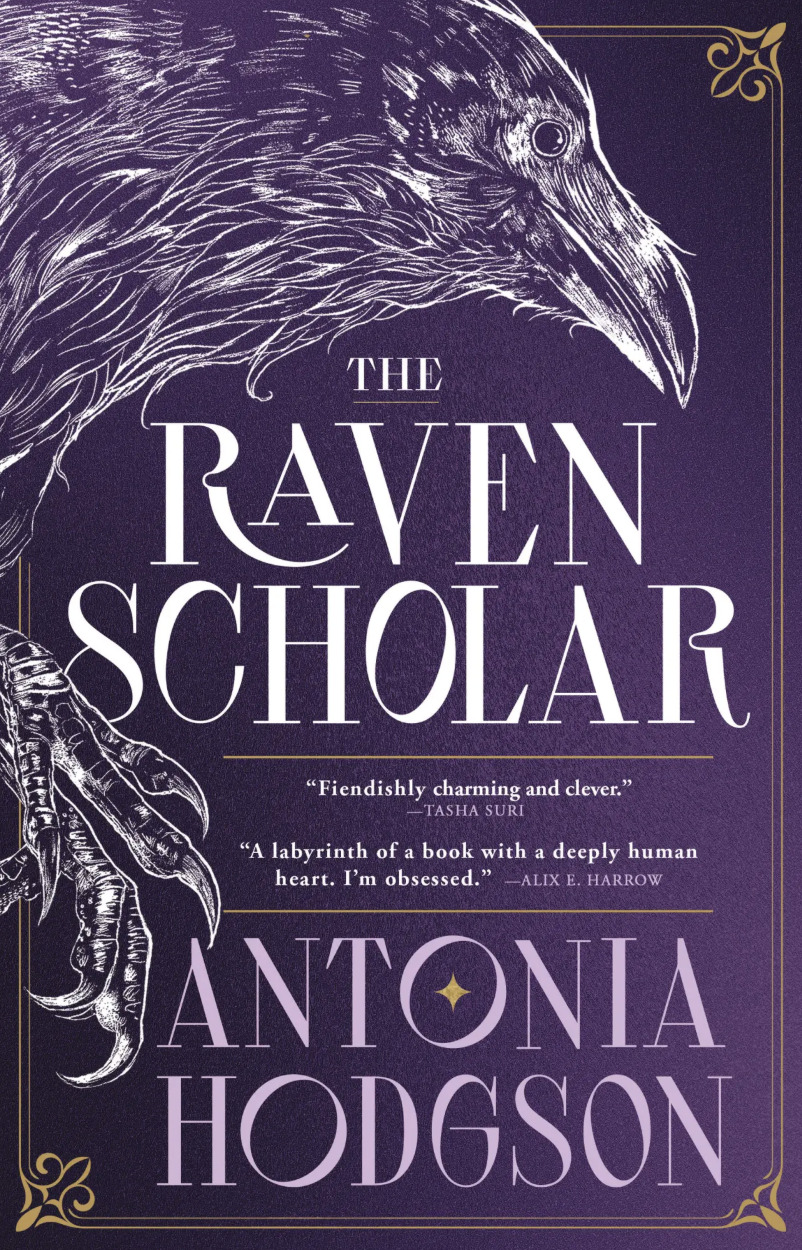
There is a specific pleasure in discovering a debut that knows exactly what it is and executes its intentions with complete confidence. The Raven Scholar, Antonia Hodgson's first fantasy novel, is the opposite of timid. At over 600 pages, it is not a book that hedges its ambitions or tests the water with a shorter form. It arrives fully assembled — a murder mystery nested inside a tournament competition for a vacant throne, with a cast of several dozen characters, a fully realised political system, and a heroine who is specifically described as "prickly, socially awkward, and frequently unlikable" — and it sustains that assemblage across every one of those pages without losing either its momentum or its control.
Den of Geek named it the most delightful surprise of 2025. The phrase understates the achievement. The Raven Scholar is not merely a pleasant discovery. It is the arrival of a significant new voice in the genre, from an author who spent years writing historical mysteries and has brought everything she learned in that form into fantasy.
The Setup
Neema Kraa is a scholar — socially marginal, professionally competent, unused to being the center of attention and entirely unsuited to the political theater that surrounds a succession crisis. When the king dies without an obvious heir, a competition is announced: the claimants to the throne will be assessed across a series of trials. Neema becomes involved when a death occurs that is officially not a murder and that she recognizes, immediately, as one.
What Hodgson has constructed around this premise is a mystery in the true classical sense — the information the reader needs is present in the text, the villain is among the named characters, and the resolution is logically defensible — married to a fantasy world with genuine political depth. The kingdom of Nine Lands is not described through a gazetteer of worldbuilding; it is revealed through the specific pressures its institutions place on the people who inhabit them. Neema's awkwardness is not incidental — it is a product of what her world requires of people in her position and what she is constitutionally unable to provide.
The Heroine Problem
Fantasy has produced a surplus of heroines who are defined primarily by their exceptionalism — who stand apart from the social order not because of its specific structure but because the narrative has decided they deserve to. Neema Kraa is exceptional, but her exceptionalism is specific and costly. She is exceptionally good at reading texts and exceptionally bad at reading rooms. In a competition structured around political performance, the second limitation matters more than the first.
Hodgson does not solve this by having Neema transcend it. The awkwardness remains throughout. She makes social errors that have consequences. She misreads the motivations of people she is supposed to be investigating. The gap between her analytical intelligence and her interpersonal intelligence is the engine of the novel's comedy and a genuine source of tension — because the murder she is trying to solve is surrounded by people who are very good at exactly the kind of performance Neema cannot manage, and some of those people have an interest in her not succeeding.
The result is a protagonist whose limitations are functional rather than cosmetic, and whose arc — which is not a transformation into someone different, but a deepening understanding of what she already is — feels genuinely earned.
The Plot Architecture
The construction of The Raven Scholar is its most technically impressive quality. Hodgson manages a very large cast without losing track of any of them, distributes her clues with the precision of someone who has spent years in the mystery form, and pivots her genre frame — several times, in ways that a summary would spoil — without disrupting the coherence of what has come before.
This is difficult. Fantasy that operates as mystery typically fails at one of two things: either the mystery is solved too easily because the fantasy world has magical methods of detection that make conventional deduction redundant, or the fantasy elements are so underdeveloped that the mystery overwhelms them. Hodgson avoids both failures by ensuring that the two modes work on each other — the political and religious specifics of Nine Lands shape what kinds of crimes are possible and what kinds of investigation are permitted, and the mystery's logic is inseparable from the world's logic.
The 600-page length is earned rather than indulgent. Every chapter feels relevant — Hodgson is writing about a world that exists well beyond the page, and the sense of extension, of things happening off-screen that will matter later, is one of the qualities that makes The Raven Scholar feel like the first volume of something larger rather than a standalone experiment.
The Literary Context
Hodgson's background is in historical fiction — specifically the Thomas Hawkins mystery series, set in eighteenth-century London — and that background is visible in The Raven Scholar in the best possible ways. The handling of institutional power, the understanding of how social position determines what information is available to any given character, the construction of a murder mystery that is genuinely solvable rather than dependent on revelation — these are skills developed in a different form and deployed here with the confidence of someone who has had years to refine them.
What she has added — the fantasy world, the mythology, the political architecture of the competition — does not feel like an imposition on the mystery form. It feels like an expansion of it, a recognition that the questions the mystery form asks about truth and motive and who gets to determine what happened are more interesting when the institutional structures surrounding those questions are specifically unusual.
A Recommendation Without Reservation
The Raven Scholar is not a safe recommendation — at 600-plus pages with a large cast and a prickly protagonist, it asks something of the reader's patience and attention. It repays that patience in full.
For readers of this library whose primary interest is in the darker end of the fantasy spectrum, it may initially seem like a different kind of book. It is morally complex rather than morally bleak, and its relationship with violence is more oblique than direct. But its engagement with power — with who holds it, how it is transferred, what it costs — belongs to the same tradition as the books that define this library's collection.
It is the debut of a writer who knows what she is doing. The sequel, reportedly in progress, will be taken seriously from the first page.