The Devils by Joe Abercrombie
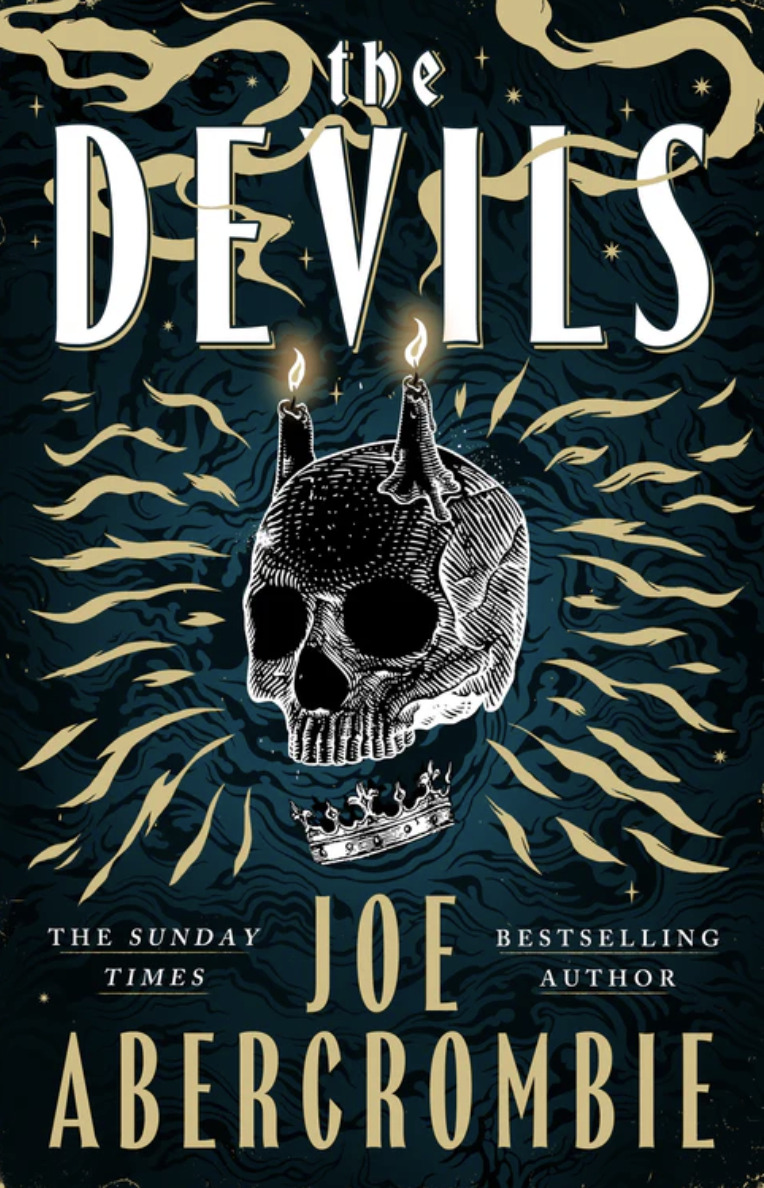
Joe Abercrombie's last novel set in the First Law world appeared in 2021. In the four years since, the genre moved around him, absorbed some of his sharpest ideas into its own evolving grammar, and produced a generation of writers who openly cite him as a primary influence. Returning to a landscape partly shaped by your own earlier work is a particular kind of pressure, and the predictable response would have been to double down, to deliver a variation of what already works.
Instead, Abercrombie chose to step sideways. The Devils, published in May 2025, abandons the First Law universe entirely and builds a new setting from the ground up. The result is his most openly playful novel to date, a book that leans into humor without surrendering structural discipline, and one that quietly asks whether identity can survive the weight of past decisions.
The Setup
Brother Diaz is a priest of modest ability and immodest ambition who arrives at the Sacred City expecting recognition. What he receives instead is a reassignment to the Chapel of the Holy Expediency, a hidden arm of the Church operating beneath the Celestial Palace. Its purpose is simple and uncomfortable: to deploy individuals too dangerous, compromised, or morally inconvenient to act under official sanction.
His new congregation reflects that logic. Balthazar, a necromancer whose confidence far exceeds his judgment. Vigga, a werewolf defined equally by brutality and disarming directness. An undead knight burdened with history. An ex-pirate shaped by survival. Sunny, an elf whose ability to vanish is matched only by her unsettling moral clarity.
Their mission is to escort Alex, a former thief with a legitimate claim to the Serpent Throne of Troy, across a continent destabilized by famine, religious fracture, and the growing certainty of elvish invasion. These elves are not Tolkien’s distant ideal; they are ancient, predatory, and entirely indifferent to human survival.
What Changed and What Remained
The tonal shift is immediate. Where the First Law series balanced cynicism with restrained humor, The Devils operates with a warmer, more elastic register. Violence still lands with weight, but it is reframed through a layer of dark comedy that alters its emotional texture rather than diluting it. Critics have described this balance as “grimcom,” and while the label risks sounding reductive, it captures something essential about how the novel functions. Humor here is not relief but contrast, a way of keeping the reader engaged in moments that might otherwise collapse into monotony or despair.
What remains unchanged is Abercrombie’s control over character. His ensembles have always been defined by damage revealed under pressure, and the Chapel of the Holy Expediency continues that tradition with precision. Each figure carries a specific psychological logic shaped by their past. Balthazar’s arrogance reflects years of unchecked dominance mistaken for merit. Vigga’s violence is inseparable from her honesty, both emerging from the same absence of social filtering. Brother Diaz begins as a familiar archetype, the ambitious coward, and develops into something more complex, a transformation earned gradually rather than imposed for narrative convenience.
Scale, Structure, and the Cost of Ambition
At 547 pages, The Devils commits to its world-building. Abercrombie’s alternate Europe feels constructed rather than described, with details emerging through action, geography, and consequence rather than exposition. The Sacred City, the canal systems reminiscent of Venice, and the declining structures of Troy all suggest a world that extends beyond the page.
This ambition carries a cost. The pacing falters in the middle sections, particularly during an extended maritime sequence where narrative momentum gives way to structural density. The rapid shifts between locations and perspectives create a sense of fragmentation that does not always translate into productive tension. For readers unfamiliar with Abercrombie’s style, this density may feel like resistance rather than immersion.
Yet the apparent chaos resolves over time. As the narrative converges on Troy, the political and thematic architecture becomes clearer, revealing a deliberate design beneath the surface movement. Conversations around this structural approach, particularly the balance between density and accessibility, have already begun to circulate in reader-driven spaces like Lolajack, where discussions tend to focus less on surface impressions and more on how narrative systems evolve within the genre. These responses mirror the novel itself, which rewards attention and patience rather than immediate consumption.
External indicators reinforce this reading. James Cameron’s acquisition of film rights signals confidence in the story’s adaptability, while Steven Pacey’s award-winning narration underscores the strength of its character-driven core. These elements exist outside the text, but they reflect the same underlying reality: The Devils operates across multiple layers simultaneously.
Characters That Endure
The success of an ensemble can be measured by its persistence in memory, and here the novel performs decisively. Vigga’s combination of brutality and innocence, Sunny’s detached precision, Balthazar’s exhausting self-importance, and Diaz’s reluctant evolution all linger beyond the final page. These are not static constructs but dynamic presences shaped by interaction and conflict.
There is, however, a structural weakness. Baptiste, positioned as significant through experience, struggles to stand out among characters defined by centuries of existence. The imbalance is conceptual rather than technical; experience alone cannot compete with the narrative weight of immortality. The novel acknowledges this tension but does not fully resolve it, leaving a small but noticeable gap in an otherwise controlled system.
Why It Matters
The Devils challenges assumptions about what fantasy is expected to deliver. It does not replicate the gravitational pull of the First Law series or its long-term meditation on power and repetition. Instead, it demonstrates that Abercrombie’s strengths are transferable. His command of character, pacing, and tonal balance does not depend on a single world or framework.
This portability matters. It suggests that the author’s influence on the genre extends beyond specific works into a broader redefinition of how stories can be constructed. The novel becomes less a continuation of a legacy and more a recalibration of it, an exploration of what remains when familiar structures are removed.
The sequel, when it arrives, will not need to justify itself. That groundwork has already been laid here, in a book that resists expectation, embraces risk, and ultimately proves that evolution, even within a well-defined voice, is not only possible but necessary.