
The Lies of Locke Lamora by Scott Lynch: A Thief's Education in a City That Wants Him Dead
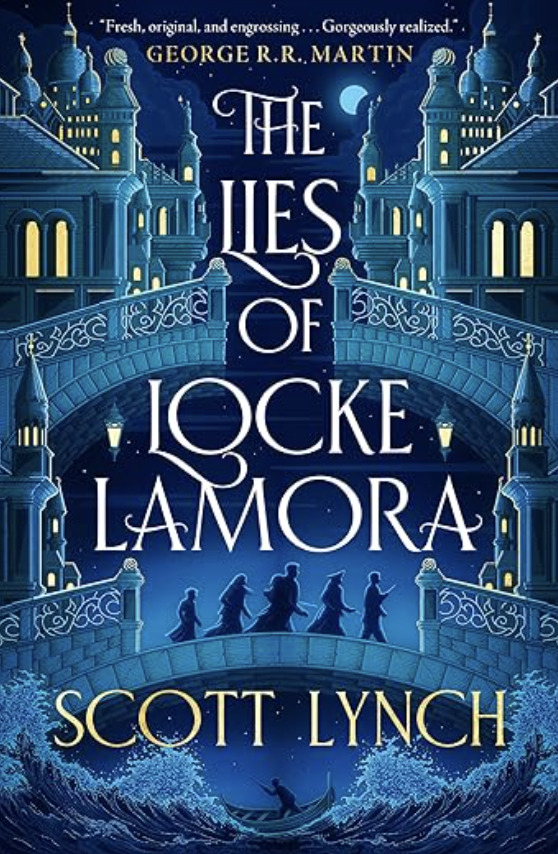
There is a moment, roughly a hundred pages into The Lies of Locke Lamora, when you realise that you are not reading what you thought you were reading. The setup has been charming — a gang of elaborate con artists in a fantastical city, pulling off increasingly audacious schemes against the nobility, the sort of premise that promises sophisticated entertainment and generally delivers something slightly less. Then Scott Lynch does something the premise hasn't prepared you for, and the novel becomes something else entirely. Something harder and more consequential and considerably more serious about what it wants to say.
What it wants to say, it turns out, is quite a lot. The Lies of Locke Lamora is one of the most purely enjoyable fantasy novels of the last twenty years, and also, underneath the enjoyment, one of the angrier.
Camorr: The City as Character
Before Locke, before the plot, there is Camorr. The city is built on and around the ruins of a vanished civilisation — the Eldren, who left behind structures of a glass-like material that cannot be damaged, cannot be explained, and cannot be replicated. The Verrari glass towers rise above Camorr's actual buildings the way history rises above the present: inexplicable, beautiful, and entirely indifferent to what happens in their shadow.
Lynch built Camorr from the bones of Renaissance Venice — the canals, the merchant districts, the elaborate social stratification, the coexistence of enormous wealth and spectacular violence within a few blocks of each other. The result is a city with genuine texture. Not a fantasy city that gestures at Venice, but a place that feels inhabited, with specific neighbourhoods that have specific characters, specific social rules that are followed and broken in specific ways, a criminal underworld organised with the efficiency of a guild and the ruthlessness of a particularly amoral bureaucracy.
The city is where the plot lives, and Lynch knows it. Every significant development in the story is shaped by the geography and social structure of Camorr in ways that feel inevitable rather than constructed. The setting is not background. It is the pressure the characters operate under.
The Gentleman Bastards
Locke Lamora leads a small gang called the Gentleman Bastards — the orphan graduates of a criminal education delivered by a priest named Father Chains, who taught them not just how to pick pockets and pick locks but how to be anyone. To perform any social role. To disappear into whatever identity the con requires and emerge, when it's over, having taken everything that wasn't nailed down and several things that were.
The ensemble is constructed with care. Jean Tannen — Locke's closest friend, a large man who reads voraciously and carries two hatchets when the situation requires — is the novel's most straightforwardly sympathetic figure, and among the best-drawn supporting characters in the genre. The Sanza twins, Bug, Calo — each has enough personality to carry scenes independently, enough history with Locke to explain the dynamics between them, enough specificity to feel like people rather than positions in a heist movie ensemble.
The flashback structure Lynch employs — alternating chapters that show the Bastards' education under Father Chains with the present-day action — serves two purposes simultaneously. It builds the world and the characters' history efficiently without stopping the narrative for expository lumps. And it creates an ongoing dramatic irony: the reader knows things about who these characters are becoming that the characters within the flashbacks do not. The education in the flashbacks is touching and often funny. Knowing what some of them will face makes it something else.
The Con and What Disrupts It
The Bastards' primary operation, when the novel opens, involves elaborate long cons on Camorr's nobility — performances that require months of preparation, multiple false identities, a detailed understanding of their marks' psychology, and a willingness to sustain an illusion under significant social pressure. Lynch's descriptions of these cons are among the novel's most pleasurable passages. He has done the work of understanding how confidence trickery actually operates — the way it exploits social expectation, the specific vulnerabilities of wealth and status, the performative work of maintaining a false persona over extended time — and the Bastards' operations feel genuinely intelligent rather than conveniently so.
Then an outside force enters Camorr. A figure called the Grey King, operating with violence that makes the criminal underworld's ordinary ruthlessness look restrained, begins systematically dismantling the city's crime bosses. The Bastards become entangled in ways they did not choose and cannot easily escape. And the novel, which has been operating as a sophisticated comedy of manners with criminal protagonists, reveals that it has been building toward something considerably darker.
The shift is where Lynch demonstrates what he is actually capable of. The tone doesn't simply change — it deepens. The playfulness of the heist sections earns the weight of what follows, because the reader has spent enough time with these characters to feel the stakes as personal rather than abstract. This is the specific achievement of the slow build, the investment paid off.
What the Book Is Angry About
Underneath the con artistry and the violence and the elaborate worldbuilding, The Lies of Locke Lamora is a novel about what societies do with the people they produce through poverty and violence and neglect, and what those people do in return.
The nobility of Camorr are not simply rich. They are protected — by the Secret Peace, a long-standing arrangement between the criminal underworld and the city's rulers that keeps the thieves from preying on the wealthy in exchange for the wealthy leaving the underworld's internal operations alone. The Gentleman Bastards break this arrangement deliberately. Their long cons target specifically the nobility. The moral logic they operate on — that the social compact of Camorr is already a form of organised theft, and that they are simply being honest about it — is never made explicit, but it is present in every page.
Lynch does not deliver this argument as a lecture. He delivers it as a plot, which is considerably more effective. By the time the novel reaches its conclusions, the reader has absorbed a fairly sophisticated critique of how class and criminality interrelate without ever having sat through a paragraph that felt like an essay.
The Sequels and the Long Wait
The Lies of Locke Lamora was followed by Red Seas Under Red Skies in 2007 and The Republic of Thieves in 2013 — a six-year gap explained partially by Lynch's serious illness during that period, which he has discussed publicly. The fourth volume, The Thorn of Emberlain, has been in progress for years and has not yet appeared. For readers who love these characters — and they are the kind of characters who generate that response — the wait is genuine.
What the first novel offers, independent of what comes after, is entirely sufficient. A city built to be inhabited. Characters built to be cared about. A plot that earns every turn it makes. And underneath all of it, the controlled anger of a writer who has thought carefully about who stories are for and who tends to get left out of them.
Locke Lamora gets left out, in Camorr's official reckoning. He returns the favour comprehensively.