The Problem With Fantasy Maps (And Why We Love Them Anyway)
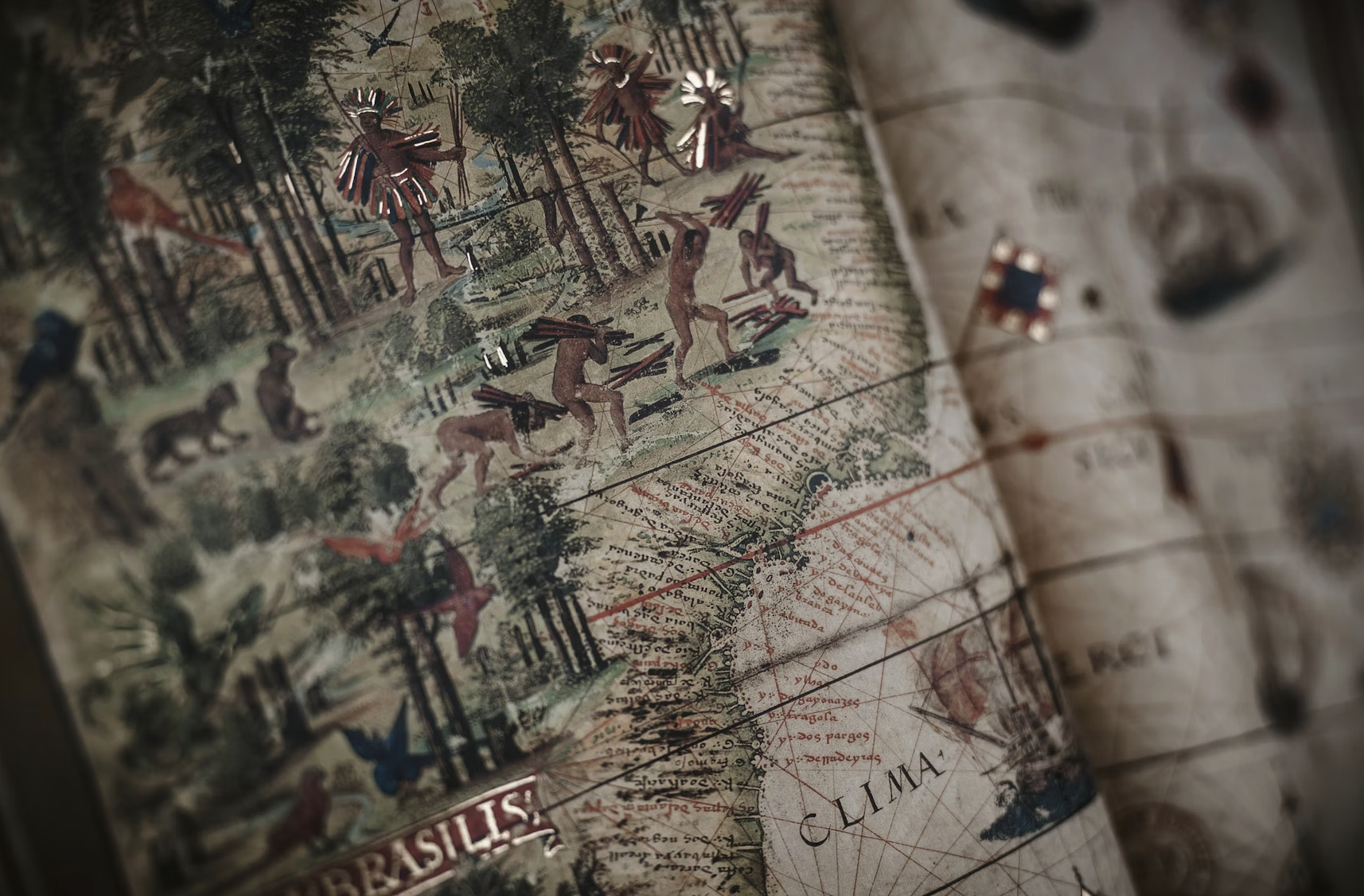
Before the story begins, there is a map.
It is almost always there, on the two pages that face each other before chapter one. Coastlines drawn by someone who has either studied actual medieval cartography or is extremely good at approximating it. Mountain ranges rendered as small repeated triangles, because triangles are what mountains look like in this particular artistic tradition. Rivers that, upon close examination, sometimes flow uphill. Cities marked with dots or small tower icons, named in a font that leans slightly italic as if to signal both antiquity and significance.
And before you have read a single sentence of the novel, you are already studying this map. You are orienting yourself. You are running your eyes along the distances between named places, doing the informal calculation of which places will matter and which are named only to suggest that the world extends beyond the narrative's frame. You are looking for the shape of the story in the geography before the story has begun to tell you its shape directly.
Fantasy maps are almost never good as maps. They are almost always good at something else entirely. Understanding what that something else is requires understanding what maps are actually for — and what fiction needs that maps, for all their limitations, uniquely provide.
The Problem, Stated Honestly
A real map is a tool for navigation. It represents spatial relationships with enough accuracy that a person can use it to move from one place to another without getting lost. This requires, at minimum: consistent scale, accurate relative distances, meaningful topography, and a north that stays north regardless of where on the map you are looking.
Fantasy maps fail at most of these requirements, routinely and without apology. The distances are inconsistent — a character walks from City A to City B in three days and then covers what looks like a shorter distance in two weeks, and the map offers no useful clarification because the scale is decorative rather than functional. The rivers frequently violate hydrology. The mountain ranges are often placed where they are dramatically useful rather than where geological logic would put them. Coastlines have a fantasy-coastline quality — the curves are pleasing, the harbours are abundant, the geography has been designed by someone who was thinking about aesthetics and geopolitical plausibility in roughly equal measure.
None of this matters to the reader experiencing the map. Because the reader is not trying to navigate. They are trying to inhabit.
What Fantasy Maps Are Actually For
The fantasy map's primary function is not spatial information. It is world signal. The presence of a map at the front of a novel tells the reader, before a single sentence of prose, three things: this world is large, this world is internally consistent, and this world has been thought about.
The third point is the most important. A map is evidence of labor — of someone having spent time with the geography, having decided where the rivers go and where the mountain ranges create political boundaries and where the sea routes would naturally form. Whether that labor is actually legible in the map's accuracy is almost secondary. The map's presence is the argument that the argument has been made.
Tolkien, who is responsible for much of the modern tradition of fantasy cartography, was a genuine amateur geographer who drew and redrew his maps of Middle-earth repeatedly, adjusting them for internal consistency and integrating them with the linguistic and historical work he was doing simultaneously. His maps are, for a fantasy world, unusually good at being maps. The distances are more or less consistent. The topography has been thought through. You can, with some confidence, use his maps to trace the Fellowship's route and have the distances make rough sense.
Most subsequent fantasy maps are Tolkien's maps filtered through artistic imitation by people who did not do the underlying geographic work. They look like Tolkien's maps. They signal what Tolkien's maps signal. They do not, in most cases, achieve what Tolkien's maps achieved. And this is fine — because what most readers need from the map is not what a cartographer needs. They need the feeling of arrival in a world that has been made.

The Specific Pleasure of Map-Reading
There is a particular activity that fantasy readers engage in that has no formal name but is universally practiced: pre-reading the map.
You receive the novel. Before you read chapter one, you open to the map and spend some time with it. You identify the major named locations. You notice which names recur on the front cover or in the chapter headings or in the back-cover copy. You make preliminary hypotheses about the geography of the story — which conflicts the mountain ranges will define, which sea routes will matter, which city is far enough from the central action to seem like a destination the protagonist will eventually need to reach.
This is not reading. It is something closer to exploration. You are wandering a territory you do not yet inhabit, noting landmarks you do not yet know the significance of. When you later encounter those landmarks in the text, the map has prepared you for them in a way that is distinct from the preparation the text itself provides. The map's version of a city is silence — just a dot and a name. The text's version adds sound and smell and people and politics. The gap between the two versions, traversed over the course of reading, is part of the pleasure.
The Maps That Are Genuinely Good
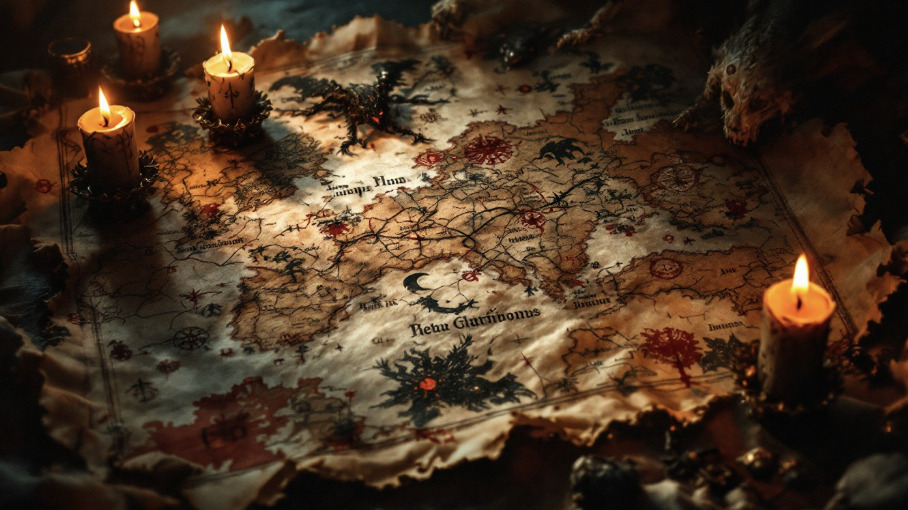
Not all fantasy maps are created equal, and some are worth examining as achievements in their own right.
Tolkien's maps for Middle-earth are the standard against which others are measured, and the standard holds. Christopher Tolkien's compilations include many of his father's drafts and working maps, which show the revisions clearly — the process of arriving at internal consistency rather than the polished final product presented in the published novels.
Daniel Reeve, who drew the maps for the Peter Jackson films, brought a different tradition — that of medieval manuscript illumination — to a version of Middle-earth that needed to work cinematically and in close-up, and produced some of the most beautiful fantasy cartography in recent memory.
The maps in Brandon Sanderson's Stormlight Archive books are, within the context of epic fantasy, unusually geologically considered — the Shattered Plains in particular are clearly the product of someone having thought about what would cause that particular pattern of cracking, even if the answer involves magic rather than geology. Isaac Stewart, who creates the maps and visual materials for Sanderson's Cosmere novels, approaches them as a visual artist working within a design system rather than as a pure cartographer, and the results achieve a consistency that rewards close attention.
Joe Abercrombie's maps of the Circle of the World are interesting for a different reason: they are conspicuously rough. The edges of the known world are explicitly labelled as uncertain, the interior of major landmasses is marked as unexplored, and the overall impression is of a map made by someone within the world rather than a god's-eye view from outside it. This is a deliberate and intelligent choice for a series that is, among other things, about the limits of perspective and knowledge.
Why the Tradition Survives
Every few years, someone argues that fantasy maps are an outdated convention — a leftover from Tolkien that the genre should feel free to abandon. The argument is not without merit. Some novels are better served by a sense of spatial ambiguity; some worlds are damaged by being pinned down in two dimensions. Ursula K. Le Guin's Earthsea books have maps, but she was explicit that the archipelago's geography was not quite stable — that the islands existed in a relationship to each other that cartography flattened in ways that missed the point.
But the tradition survives because it fulfils a real function that is difficult to achieve through prose alone. It gives the reader somewhere to stand before the story begins. It externalises the world's structure in a form that can be returned to — checked, consulted, used as a spatial anchor when the narrative's geography becomes complex. And it makes the implicit argument, at the novel's very threshold, that this world is worth a map. That someone cared enough about it to render it in two dimensions, however imperfectly.
The map is not a promise that the world is real. It is a promise that someone made it with their hands, which is something almost as good.