The Poppy War by R.F. Kuang: A Fantasy Novel That Does Not Let You Look Away
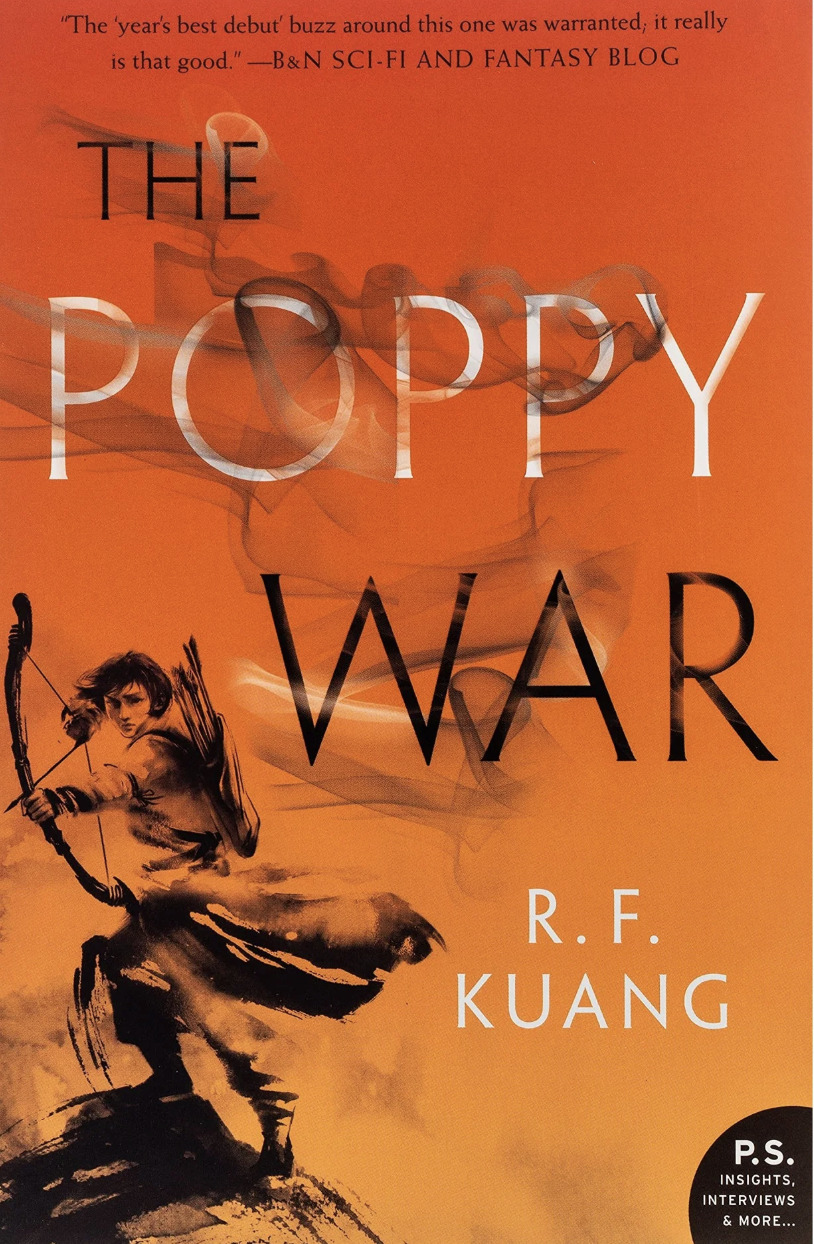
R.F. Kuang was twenty-two years old when she finished The Poppy War. She had written it as a college student, in the margins of an undergraduate degree, driven — by her own account — by frustration at the absence of Chinese history in the fantasy she was reading and a specific, consuming need to process what she had learned about the Second Sino-Japanese War. The result is one of the most disturbing debut novels the genre has produced: a book that begins as a school story, accelerates into a war narrative, and ends in territory so dark that readers often describe the experience of finishing it as something other than reading. More like surviving.
It is also extraordinary.
The First Act: The School
Rin is a war orphan from the south of the Nikara Empire, a girl who has grown up working in an opium-dealing foster family and who passes the national exam — the Keju — not by talent alone but by sheer ferocity of will, memorising texts in the dark after the household sleeps. The score earns her admission to Sinegard, the empire's most elite military academy. She arrives knowing she does not belong and proceeds to earn her place through the same combination of ferocity and desperation that got her there.
The Sinegard section is where the novel does something quietly sophisticated: it convinces you, thoroughly, that this is the kind of fantasy you know how to read. There are teachers with eccentric methods and dangerous secrets. There are class hierarchies to be dismantled. There are training sequences and competitive examinations and the specific social texture of an institution that produces warriors from children. It is well done. The characters have weight. Rin's friendships and enmities feel genuine, and the mystery of what Sinegard is actually training its students to do — a mystery the school itself doesn't fully understand — generates real suspense.
Kuang is building something. The school is a trap, and the reader is inside it with Rin.
The Second Act: The War
The Federation of Mugen attacks Nikara, and everything the first act established — the relationships, the hierarchies, the sense that this is a story with rules — comes apart. The war sections are where The Poppy War reveals what it is actually about, and where Kuang's decision to base her fantasy world on twentieth-century Chinese history becomes impossible to ignore.
The Federation is imperial Japan. The Longbow Island massacre is the Rape of Nanjing. The Mugenese biological experiments have a direct historical analogue in Unit 731. Kuang does not soften these correspondences. She does not use fantasy as a buffer that allows the reader to process at a safe distance. The violence in the war sections of The Poppy War is specific and unflinching, and it is specific and unflinching because the history it is drawing from is specific and unflinching — because the events it fictionalises were actually done to actual people and are, in much of the Western world, not known in the way they should be.
This is the argument the novel is making about what fantasy is for. Not escape. Not the comfortable processing of themes at a mythological remove. Direct engagement with the worst of what humans do to each other, made visceral by the imaginative investment the genre uniquely enables.
Rin and the Shamanism
Rin's specific power — she is revealed to be a shaman who can channel the Vermillion Phoenix — is handled with more care than most fantasy systems of magic, and for a specific reason. The shamanism in The Poppy War is not a superpower in any comfortable sense. It is a form of possession that costs the user their sanity by degrees. Every time Rin calls on the Phoenix, she burns away something of herself that cannot be recovered.
This is not a metaphor, exactly — the mechanics are literal within the world of the novel. But it functions as one anyway. The burning away of self that sustained proximity to atrocity produces, the way that war reshapes the people who fight in it into people who can no longer entirely inhabit ordinary life — these are things the shamanism system is built to carry. Rin does not become more powerful over the course of the novel in the conventional fantasy sense. She becomes more capable and more damaged simultaneously, and the two processes are inseparable.
By the end of the first book, Rin has done something that cannot be taken back. The question of whether what she did was justified, necessary, monstrous, or all three at once is left genuinely open — not as a puzzle with a solution, but as the kind of moral question that does not have a clean answer.
What Kuang Is Doing That Most Fantasy Does Not
The grimdark tradition — the strand of fantasy most willing to use darkness as serious material rather than backdrop — has produced a great deal of morally complex fiction. What distinguishes The Poppy War within that tradition is the specificity of the historical engagement. This is not a novel that uses vaguely medieval brutality as atmosphere. It is a novel that has studied what happened at Nanjing, and at Harbin, and across the Chinese theater of the Second World War, and has decided that the fantasy genre is an appropriate vehicle for making those events felt by readers who might otherwise encounter them only as historical abstractions.
Whether that decision is successful depends, to some extent, on what the reader brings to it. Readers who find the violence gratuitous have encountered a legitimate response to genuinely difficult material. Readers who find it necessary have encountered a different but equally legitimate response. Kuang herself has addressed this tension directly in interviews, arguing that the violence is not incidental to the novel's purpose — it is the purpose. The book is asking you to feel the weight of what happened. The discomfort is the point.
The Trilogy and What Comes After
The Poppy War is the first book of a trilogy. The second volume, The Dragon Republic, continues Rin's story through a civil war that draws from Chinese history's post-WWII period. The third, The Burning God, brings the trilogy to a conclusion that critics have described as devastating, earned, and in some respects the most politically serious ending the grimdark genre has produced.
Kuang has since published Babel, or the Necessity of Violence — a historical fantasy set in nineteenth-century Oxford, concerned with colonialism and the extraction of meaning from language — which received the Hugo, Nebula, and World Fantasy Awards and confirmed that her debut was not a fluke. She is one of the most significant voices in contemporary fantasy, and The Poppy War is where that voice arrived fully formed, at twenty-two, and announced that the genre had some catching up to do.
It is not an easy read. That is the most honest thing that can be said about it, and the most important.